Open In Colab

Make data stationary

  • differencing : \(y_t - y_{t-1}\)

  • [“11/07/2025” ,“12/07/2025”, “13/07/2025”, “14/07/2025”, “15/07/2025”, “16/07/2025”]

  • [4,2,1,2,3,5]

  • [NA , -2,

import pandas as pd

# Create sample time series data (unsorted)
data = {
    'Date': ['2020-03-01', '2020-01-01', '2020-02-01', '2020-01-13', '2020-01-16', '2020-01-16'],
    'Value': [300, 100, 200, 200, 300, 400]
}
df = pd.DataFrame(data)
df['Date'] = pd.to_datetime(df['Date'])
df.set_index('Date', inplace=True)
df = df.sort_index()
df
Value
Date
2020-01-01 100
2020-01-13 200
2020-01-16 300
2020-01-16 400
2020-02-01 200
2020-03-01 300
df["Value"].diff()
Value
Date
2020-01-01 NaN
2020-01-13 100.0
2020-01-16 100.0
2020-01-16 100.0
2020-02-01 -200.0
2020-03-01 100.0

#import data

# Load the libraries
import numpy as np
import pandas as pd
import matplotlib.pyplot as plt
# Using airline passenger dataset (monthly totals)
url = 'https://raw.githubusercontent.com/jbrownlee/Datasets/master/airline-passengers.csv'
df = pd.read_csv(url, parse_dates=['Month'], index_col='Month')
df
Passengers
Month
1949-01-01 112
1949-02-01 118
1949-03-01 132
1949-04-01 129
1949-05-01 121
... ...
1960-08-01 606
1960-09-01 508
1960-10-01 461
1960-11-01 390
1960-12-01 432

144 rows × 1 columns

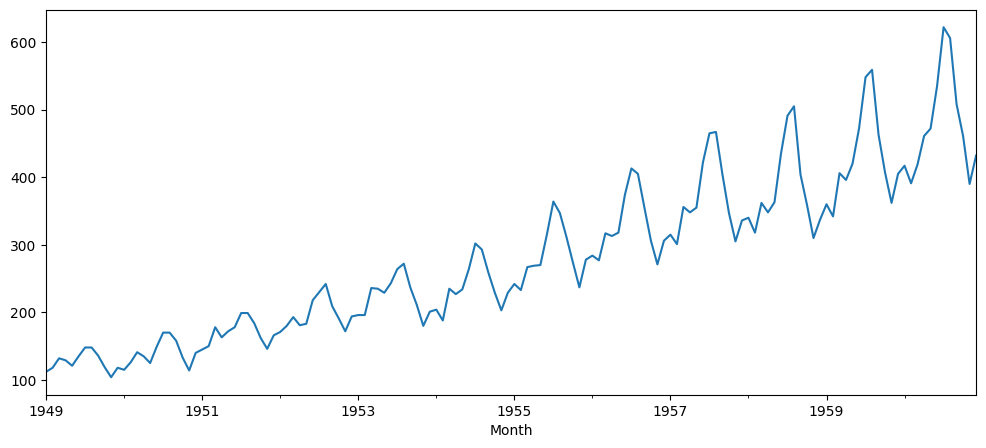
df["Passengers"].plot(figsize = (12,5))

from statsmodels.tsa.stattools import adfuller, kpss
dftest = adfuller(df["Passengers"], autolag='AIC')
dfoutput = pd.Series(dftest[0:4], index=['Test Statistic','p-value','#Lags Used','Number of Observations Used'])
for key,value in dftest[4].items():
  dfoutput['Critical Value (%s)'%key] = value
dfoutput
0
Test Statistic 0.815369
p-value 0.991880
#Lags Used 13.000000
Number of Observations Used 130.000000
Critical Value (1%) -3.481682
Critical Value (5%) -2.884042
Critical Value (10%) -2.578770

kpsstest = kpss(df["Passengers"], regression='ct', nlags="auto")
/tmp/ipython-input-4267114024.py:1: InterpolationWarning: The test statistic is outside of the range of p-values available in the
look-up table. The actual p-value is greater than the p-value returned.

  kpsstest = kpss(df["Passengers"], regression='ct')
kpss_output = pd.Series(kpsstest[0:3], index=['Test Statistic','p-value','#Lags Used'])
for key,value in kpsstest[3].items():
  kpss_output['Critical Value (%s)'%key] = value
kpss_output
0
Test Statistic 0.09615
p-value 0.10000
#Lags Used 4.00000
Critical Value (10%) 0.11900
Critical Value (5%) 0.14600
Critical Value (2.5%) 0.17600
Critical Value (1%) 0.21600

  • Case 3: ADF concludes non-stationary, and KPSS concludes stationary The series is trend stationary. To make the series strictly stationary, we need to remove the trend in this case. Then we check the detrended series for stationarity.
  • Case 4: ADF concludes stationary, and KPSS concludes non-stationary The series is difference stationary. Differencing is to be used to make series stationary. Then we check the differenced series for stationarity.

Differencing

df["Passengers"]
Passengers
Month
1949-01-01 112
1949-02-01 118
1949-03-01 132
1949-04-01 129
1949-05-01 121
... ...
1960-08-01 606
1960-09-01 508
1960-10-01 461
1960-11-01 390
1960-12-01 432

144 rows × 1 columns


df["difference"] = df["Passengers"].diff()
df
Passengers difference
Month
1949-01-01 112 NaN
1949-02-01 118 6.0
1949-03-01 132 14.0
1949-04-01 129 -3.0
1949-05-01 121 -8.0
... ... ...
1960-08-01 606 -16.0
1960-09-01 508 -98.0
1960-10-01 461 -47.0
1960-11-01 390 -71.0
1960-12-01 432 42.0

144 rows × 2 columns

y_t - y_{t-1} = 118 - 112 = 6

difference = df["Passengers"].diff()
difference = difference.dropna()
difference
Passengers
Month
1949-02-01 6.0
1949-03-01 14.0
1949-04-01 -3.0
1949-05-01 -8.0
1949-06-01 14.0
... ...
1960-08-01 -16.0
1960-09-01 -98.0
1960-10-01 -47.0
1960-11-01 -71.0
1960-12-01 42.0

143 rows × 1 columns


dftest = adfuller(difference, autolag='AIC')
dfoutput = pd.Series(dftest[0:4], index=['Test Statistic','p-value','#Lags Used','Number of Observations Used'])
for key,value in dftest[4].items():
  dfoutput['Critical Value (%s)'%key] = value
dfoutput
0
Test Statistic -2.829267
p-value 0.054213
#Lags Used 12.000000
Number of Observations Used 130.000000
Critical Value (1%) -3.481682
Critical Value (5%) -2.884042
Critical Value (10%) -2.578770

kpsstest = kpss(difference, regression='c', nlags="auto")
/tmp/ipython-input-3597463228.py:1: InterpolationWarning: The test statistic is outside of the range of p-values available in the
look-up table. The actual p-value is greater than the p-value returned.

  kpsstest = kpss(difference, regression='c', nlags="auto")
kpss_output = pd.Series(kpsstest[0:3], index=['Test Statistic','p-value','#Lags Used'])
for key,value in kpsstest[3].items():
  kpss_output['Critical Value (%s)'%key] = value
kpss_output
0
Test Statistic 0.023898
p-value 0.100000
#Lags Used 7.000000
Critical Value (10%) 0.347000
Critical Value (5%) 0.463000
Critical Value (2.5%) 0.574000
Critical Value (1%) 0.739000

Transformation

If my data is having low variance - np.log - np.sqrt - boxcox transformation - $Y(λ) = $ (when $ λ ≠ 0$) - \(Y(λ) = log(Y)\) (when \(λ = 0\))

At the core of the Box Cox transformation is an exponent, lambda (λ), which varies from -5 to 5. All values of λ are considered and the optimal value for your data is selected; The “optimal value” is the one which results in the best approximation of a normal distribution curve. The transformation of Y has the form: This test only works for positive data

https://www.statisticshowto.com/probability-and-statistics/normal-distributions/box-cox-transformation/

np.log(df["Passengers"])
Passengers
Month
1949-01-01 4.718499
1949-02-01 4.770685
1949-03-01 4.882802
1949-04-01 4.859812
1949-05-01 4.795791
... ...
1960-08-01 6.406880
1960-09-01 6.230481
1960-10-01 6.133398
1960-11-01 5.966147
1960-12-01 6.068426

144 rows × 1 columns


dftest = adfuller(np.sqrt(df["Passengers"]), autolag='AIC')
dfoutput = pd.Series(dftest[0:4], index=['Test Statistic','p-value','#Lags Used','Number of Observations Used'])
for key,value in dftest[4].items():
  dfoutput['Critical Value (%s)'%key] = value
dfoutput
0
Test Statistic -0.345854
p-value 0.918754
#Lags Used 13.000000
Number of Observations Used 130.000000
Critical Value (1%) -3.481682
Critical Value (5%) -2.884042
Critical Value (10%) -2.578770

from scipy import stats
df["Passengers"][df["Passengers"]>0]
Passengers
Month
1949-01-01 112
1949-02-01 118
1949-03-01 132
1949-04-01 129
1949-05-01 121
... ...
1960-08-01 606
1960-09-01 508
1960-10-01 461
1960-11-01 390
1960-12-01 432

144 rows × 1 columns


box_cox_val, lamda = stats.boxcox(df["Passengers"][df["Passengers"]>0])
lamda
np.float64(0.1480226858137178)
dftest = adfuller(box_cox_val, autolag="AIC")
dfoutput = pd.Series(dftest[0:4], index=['Test Statistic','p-value','#Lags Used','Number of Observations Used'])
for key,value in dftest[4].items():
  dfoutput['Critical Value (%s)'%key] = value
dfoutput
0
Test Statistic -1.326071
p-value 0.617162
#Lags Used 13.000000
Number of Observations Used 130.000000
Critical Value (1%) -3.481682
Critical Value (5%) -2.884042
Critical Value (10%) -2.578770

Detrending

np.arange(len(df)).reshape(-1,1)
array([[  0],
       [  1],
       [  2],
       [  3],
       [  4],
       [  5],
       [  6],
       [  7],
       [  8],
       [  9],
       [ 10],
       [ 11],
       [ 12],
       [ 13],
       [ 14],
       [ 15],
       [ 16],
       [ 17],
       [ 18],
       [ 19],
       [ 20],
       [ 21],
       [ 22],
       [ 23],
       [ 24],
       [ 25],
       [ 26],
       [ 27],
       [ 28],
       [ 29],
       [ 30],
       [ 31],
       [ 32],
       [ 33],
       [ 34],
       [ 35],
       [ 36],
       [ 37],
       [ 38],
       [ 39],
       [ 40],
       [ 41],
       [ 42],
       [ 43],
       [ 44],
       [ 45],
       [ 46],
       [ 47],
       [ 48],
       [ 49],
       [ 50],
       [ 51],
       [ 52],
       [ 53],
       [ 54],
       [ 55],
       [ 56],
       [ 57],
       [ 58],
       [ 59],
       [ 60],
       [ 61],
       [ 62],
       [ 63],
       [ 64],
       [ 65],
       [ 66],
       [ 67],
       [ 68],
       [ 69],
       [ 70],
       [ 71],
       [ 72],
       [ 73],
       [ 74],
       [ 75],
       [ 76],
       [ 77],
       [ 78],
       [ 79],
       [ 80],
       [ 81],
       [ 82],
       [ 83],
       [ 84],
       [ 85],
       [ 86],
       [ 87],
       [ 88],
       [ 89],
       [ 90],
       [ 91],
       [ 92],
       [ 93],
       [ 94],
       [ 95],
       [ 96],
       [ 97],
       [ 98],
       [ 99],
       [100],
       [101],
       [102],
       [103],
       [104],
       [105],
       [106],
       [107],
       [108],
       [109],
       [110],
       [111],
       [112],
       [113],
       [114],
       [115],
       [116],
       [117],
       [118],
       [119],
       [120],
       [121],
       [122],
       [123],
       [124],
       [125],
       [126],
       [127],
       [128],
       [129],
       [130],
       [131],
       [132],
       [133],
       [134],
       [135],
       [136],
       [137],
       [138],
       [139],
       [140],
       [141],
       [142],
       [143]])
from sklearn.linear_model import LinearRegression
# Step 1: Fit linear regression (trend) using sklearn
X = np.arange(len(df)).reshape(-1, 1)       # Time as feature
y = df['Passengers'].values                     # Passenger values
model = LinearRegression().fit(X, y)
trend = model.predict(X)
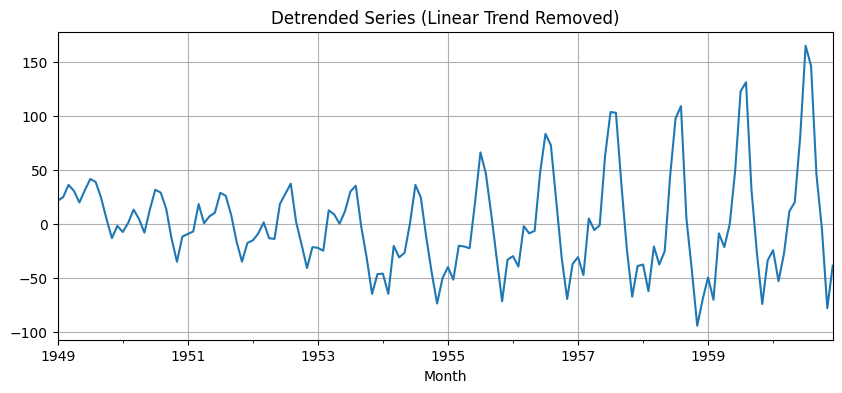
df['detrended'] = y - model.predict(X)
# Plot detrended series
df['detrended'].plot(title='Detrended Series (Linear Trend Removed)', figsize=(10, 4))
plt.grid()
plt.show()

# Step 2: Stationarity Tests
# ADF Test
adf_orig_p = adfuller(df['Passengers'])[1]
adf_det_p = adfuller(df['detrended'])[1]

# KPSS Test
kpss_orig_p = kpss(df['Passengers'], regression='ct')[1]     # trend + constant
kpss_det_p = kpss(df['detrended'], regression='c')[1]   # constant only

# Step 3: Print Results
print("📊 Stationarity Test Results")
print(f"ADF (Original):     p = {adf_orig_p:.4f}{'Non-stationary' if adf_orig_p > 0.05 else 'Stationary'}")
print(f"KPSS (Original):    p = {kpss_orig_p:.4f}{'Non-stationary' if kpss_orig_p < 0.05 else 'Stationary'}")
print(f"ADF (Detrended):    p = {adf_det_p:.4f}{'Non-stationary' if adf_det_p > 0.05 else 'Stationary'}")
print(f"KPSS (Detrended):   p = {kpss_det_p:.4f}{'Non-stationary' if kpss_det_p < 0.05 else 'Stationary'}")
📊 Stationarity Test Results
ADF (Original):     p = 0.9919 → Non-stationary
KPSS (Original):    p = 0.1000 → Stationary
ADF (Detrended):    p = 0.2437 → Non-stationary
KPSS (Detrended):   p = 0.1000 → Stationary
/tmp/ipython-input-1640147344.py:7: InterpolationWarning: The test statistic is outside of the range of p-values available in the
look-up table. The actual p-value is greater than the p-value returned.

  kpss_orig_p = kpss(df['Passengers'], regression='ct')[1]     # trend + constant
/tmp/ipython-input-1640147344.py:8: InterpolationWarning: The test statistic is outside of the range of p-values available in the
look-up table. The actual p-value is greater than the p-value returned.

  kpss_det_p = kpss(df['detrended'], regression='c')[1]   # constant only
detrended_ma = df['Passengers'] - df['Passengers'].rolling(window = 10).mean()
detrended_ma = detrended_ma.dropna()